If you've ever tried to scale a web scraping operation, run multiple social media accounts, or automate checkouts, you already know the harsh reality: cheap proxies get you banned.
While datacenter proxies might look appealing with their low price tags and unlimited bandwidth, they carry a hidden cost. They are the digital equivalent of a megaphone—fast, loud, and incredibly easy for security systems to spot. If you want to remain invisible and scale without interruption, there is only one true solution: Elite Residential Proxies. Here's why.
The Core Difference
To understand the value of a residential proxy, you must first understand the flaw of a Datacenter proxy. Datacenter proxies are hosted in massive server farms owned by companies like Amazon Web Services (AWS), Google Cloud, or DigitalOcean.
Because these IPs belong to a commercial Autonomous System Number (ASN), anti-bot systems like Cloudflare and DataDome immediately know that a request originating from AWS is not a real human browsing from their home.
Residential proxies, on the other hand, are routed through genuine devices connected to local Internet Service Providers (ISPs) like Comcast, Verizon, or AT&T. When a target website receives a request from a residential IP, it sees a real person sitting in a living room somewhere in the world. It is the ultimate disguise.
Unbeatable IP Trust Scores
Every IP address on the internet has a reputation, often referred to as a "Trust Score" or "Fraud Score." Websites use these scores to decide whether to serve you a CAPTCHA, block you entirely, or let you through.
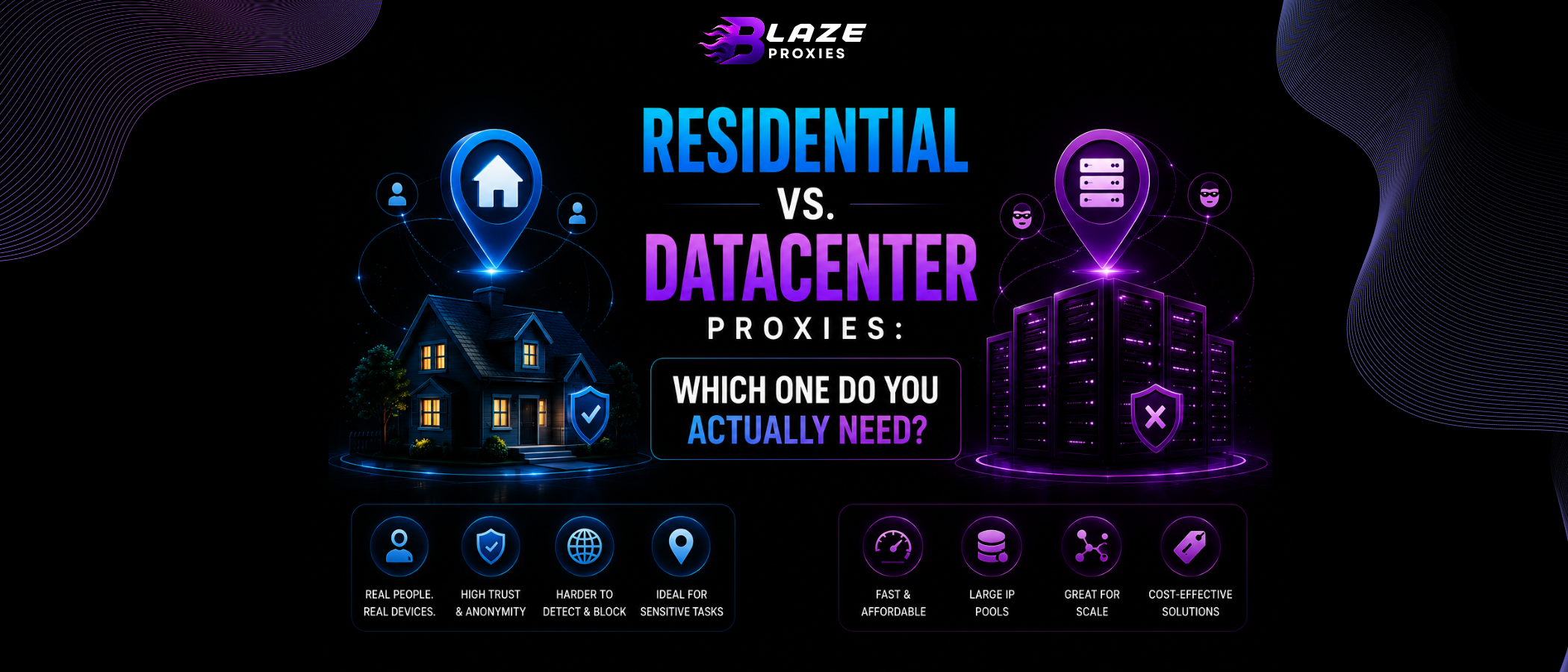
Datacenter IPs
Often shared by thousands of users and flagged as "hosting" or "proxy" by IP databases (like IP2Location or MaxMind).
LOW TRUST
Residential IPs
Assigned to regular consumers. Blacklisting a residential IP risks blocking a legitimate customer.
HIGH TRUST
By utilizing residential IPs, you bypass the preliminary security filters that rely on ASN blacklisting. If you need the trust of a residential IP but the speed of a datacenter, consider looking into our Static ISP Proxies.
Hyper-Local Global Targeting
Datacenter proxies restrict you to the physical locations where servers are built. If you need an IP from a small town in Germany, a datacenter won't help you.
Our Residential Network consists of over 20 million IPs across 229+ global locations. This allows for unparalleled targeting capabilities:
- Country Level: Scrape geo-restricted content and verify local pricing globally.
- State & City Level: Monitor localized SEO rankings (e.g., "plumbers in Austin, TX").
- ASN Level: Target specific internet providers to bypass strict regional filters.
Massive IP Pools & Rotation
When you purchase datacenter proxies, you are buying a static list of IPs (e.g., 100 IPs). If a target website bans 50 of those IPs, you've lost half your infrastructure.
Residential proxy access is sold by bandwidth (GB), not by the IP. This means you get access to the entire pool of millions of rotating IPs. If an IP gets blocked, the system instantly rotates you to a fresh, clean IP on the next request. This creates an unstoppable, self-healing scraping infrastructure.
Note: Read our advanced guide on How Residential Proxies Defeat Anti-Bot Systems for technical implementation details on IP rotation logic.
Frequently Asked Questions
A residential proxy is an IP address assigned by an Internet Service Provider (ISP) to a real homeowner. Unlike datacenter IPs, which come from server farms, residential IPs are inherently trusted by websites because they look like genuine human traffic.
Yes, residential proxies are significantly better for scraping high-security targets like e-commerce sites, social media platforms, and search engines. They bypass anti-bot systems that automatically flag and block datacenter ASN ranges.
Residential proxies are sourced from real devices worldwide, requiring complex infrastructure to maintain. You typically pay per gigabyte (GB) of bandwidth rather than per IP. However, the ROI is much higher because you avoid the downtime and bans associated with cheaper datacenter proxies.
The ROI is Undeniable.
Yes, residential proxies cost more upfront. But factor in the hours saved from unblocking IPs, fixing broken scrapers, and lost data opportunities, and elite residential networks actually save you money.
Network Size
20M+ IPs
Success Rate
99.9%
Targeting
City-Level